A newly completed building may look spotless.
The floors are polished. The walls are freshly painted. The furniture is installed. The final deep cleaning is complete.
But there is one area that is often overlooked:
Inside the HVAC system.
Construction and renovation activities can generate large quantities of fine dust and debris. If the HVAC system is not properly protected during the work—or is operated while dust-producing activities are taking place—some of that contamination can enter the air-handling equipment and ductwork.
This is why HVAC cleanliness should be considered as part of project handover and post-construction cleaning, not only after occupants begin complaining about dust or odors.
How Does Construction Dust Enter the HVAC System?
Construction generates airborne particles from activities such as:
- Gypsum-board cutting and sanding
- Concrete drilling and cutting
- Ceiling installation
- Woodworking
- Tile and stone cutting
- Painting and surface preparation
- Floor grinding and polishing
- MEP installation
- Demolition
- General site dust
HVAC systems move large volumes of air.
If supply or return openings are left exposed during construction, contaminants can enter the system.
The risk can increase when the HVAC system is operated while dusty construction work is still underway.
Isn’t a New AC System Already Clean?
Not necessarily.
New does not automatically mean clean.
Ductwork and HVAC components may be installed relatively early in a construction project. They can then remain exposed to site conditions while other trades continue working.
Dust and debris can potentially enter through:
Open duct sections → Unprotected diffusers → Return openings → AHUs → Equipment access panels
Even newly installed components should therefore be assessed based on their actual condition rather than assumed to be clean simply because they are new.
What Types of Contamination Can Be Found?
Depending on the project, post-construction HVAC contamination may include:
- Fine construction dust
- Gypsum dust
- Concrete and cement particles
- Sawdust
- Insulation fibers
- Packaging debris
- Ceiling dust
- General site debris
- Other particulate generated by construction activities
In some cases, larger foreign objects may also enter ductwork during construction.
The type and amount of contamination depend heavily on how well the HVAC system was protected throughout the project.
Which HVAC Components Should Be Inspected?
A post-construction HVAC cleanliness assessment should look beyond the visible diffusers.
Depending on the system, inspection may include:
Supply Ductwork
These ducts distribute conditioned air throughout the building.
Return Ductwork
Return systems can collect significant dust if exposed during construction.
Air-Handling Units
AHUs should be checked for accumulated debris and contamination.
Cooling Coils
Dust deposited on coil surfaces can affect HVAC cleanliness and heat transfer.
Blowers & Fans
Fan and blower assemblies can accumulate construction dust if equipment operates during site works.
Drain Pans
Drain pans should be clean and capable of draining correctly before normal operation.
VAV Boxes & Terminal Units
Commercial systems may contain additional components that should be included in the cleanliness assessment where applicable.
Grilles & Diffusers
These visible components should also be inspected and cleaned, but they represent only a small part of the complete HVAC system.
How Do You Know Whether the Ducts Need Cleaning?
Inspect first. Clean when required.
The fact that a building has undergone construction does not automatically mean every duct requires complete cleaning.
A professional assessment should determine:
- Whether contamination is present
- Where it is located
- How extensive it is
- Which HVAC components are affected
- Whether the contamination can be removed safely
- Which cleaning methods are appropriate
This avoids unnecessary cleaning while ensuring that genuinely contaminated areas are not overlooked.
What Does Professional Post-Construction Duct Cleaning Involve?
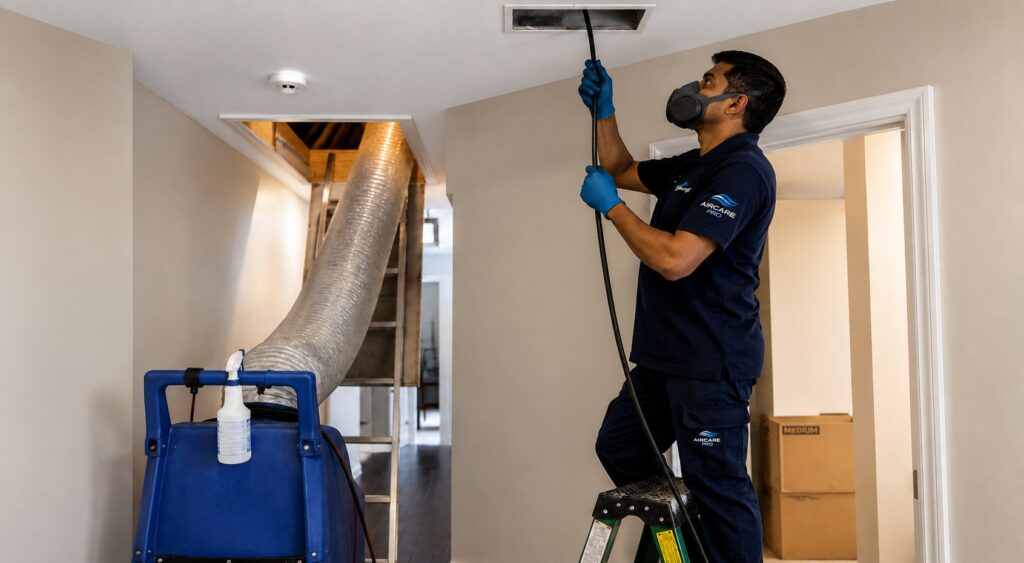
Where cleaning is required, professional HVAC cleaning should focus on source removal.
A typical process may include:
1. HVAC System Assessment
The system is inspected to determine the condition, contamination level, accessibility and appropriate cleaning method.
2. Work-Area Protection
Occupied areas, finished surfaces and sensitive equipment are protected as required.
3. Access to the Ductwork
Existing access points are used where suitable. Additional service openings may be created where necessary to properly reach internal duct surfaces.
4. Negative-Pressure Vacuum Collection
Professional vacuum collection equipment is connected to the system to establish negative pressure.
This helps control loosened particles during cleaning and directs them toward the collection equipment.
5. Mechanical Agitation
Specialized equipment is used to physically dislodge contamination from internal surfaces.
Depending on the duct construction, this may include:
- Rotary brushes
- Air whips
- Compressed-air tools
- Contact vacuuming
- Manual agitation
- Other specialized cleaning equipment
6. Contaminant Extraction
Loosened dust and debris are captured and removed from the HVAC system.
The objective is to remove contamination—not simply move it further along the ductwork.
7. HVAC Component Cleaning
Where required by the system condition and agreed scope, components such as AHUs, blower sections, coils, drain pans, grilles and diffusers may also require cleaning.
8. Cleanliness Verification
After cleaning, the system should be inspected to confirm that the required level of cleanliness has been achieved.
Documentation may include visual inspection, photographs, videos or other specified verification methods.
Why Is Negative Pressure Important?
Imagine brushing a heavily dust-covered surface inside a duct.
The contamination becomes airborne.
Without appropriate collection and containment, those particles can migrate elsewhere within the system or potentially escape into the building.
Professional HVAC cleaning therefore combines two important actions:
Agitation loosens contamination.
Negative-pressure collection captures and removes it.
This is fundamentally different from simply blowing compressed air through a duct.
Is Cleaning the Air Vents Enough?
No.
Cleaning grilles and diffusers may make the visible parts of the system look clean, but it tells you very little about the condition deeper inside.
A professional post-construction assessment may need to examine:
Diffusers → Branch Ducts → Main Ducts → Return Ducts → AHUs → Coils → Blowers → Drain Pans
If contamination is present throughout the system, wiping the visible vents does not remove the source.
Should the AC Be Operated During Construction?
Ideally, HVAC systems should be protected from construction contamination.
Dust-producing activities create a particular risk.
Supply and return openings should be protected appropriately, and operating the permanent HVAC system during heavy dust-producing work should be avoided where practical.
When operation is unavoidable for project requirements, appropriate temporary filtration and contamination-control measures should be considered.
Preventing contamination is easier than removing it later.
What Should Contractors Do to Protect New Ductwork?
Good construction practice begins before the HVAC system is commissioned.
Measures can include:
- Keeping duct sections protected during storage
- Covering open duct ends
- Protecting supply and return openings
- Preventing debris from entering installed ducts
- Coordinating HVAC work with dusty construction activities
- Using appropriate temporary filtration where required
- Keeping AHUs and equipment protected
- Inspecting the system before commissioning
The objective is simple:
Keep construction contamination out of the HVAC system from the beginning.
Should HVAC Cleaning Be Done Before or After Final Building Cleaning?
Coordination matters.
HVAC cleaning should generally be planned when major dust-generating construction activities are complete and the risk of immediate recontamination has been controlled.
If ducts are professionally cleaned and contractors then continue cutting gypsum board, grinding floors or performing other dusty work without adequate protection, the HVAC system may become contaminated again.
For project handover, the sequence should therefore be coordinated between:
Construction Completion → Dust Control → HVAC Inspection/Cleaning → Final Cleaning → Commissioning/Handover
The exact sequence may vary according to the project and commissioning plan.
What About Newly Installed Ducts?
New ductwork should still be inspected.
NADCA recommends that HVAC systems associated with construction, retrofit or remodeling projects be inspected and verified clean before they are permitted to operate.
This is particularly relevant to:
- New buildings
- Major renovations
- Office fit-outs
- Hotel renovations
- Restaurant fit-outs
- Healthcare facilities
- Schools
- Commercial buildings
- Industrial facilities
A new system should begin its operational life in an appropriately clean condition.
Can Construction Dust Affect AC Performance?
Potentially.
Accumulated debris on sensitive HVAC components can affect airflow and heat transfer.
For example, significant dust accumulation on:
- Filters
- Cooling coils
- Blower assemblies
- Other air-side components
can affect system operation.
However, it is important not to claim that duct cleaning alone will automatically reduce electricity consumption or solve every performance issue.
The entire HVAC system should be assessed.
What About Construction Dust on Cooling Coils?
Cooling coils deserve particular attention.
If an HVAC system operates during construction, airborne dust can be drawn toward the coil.
Because coil fins provide a large surface area and relatively narrow air passages, contamination can accumulate and affect airflow and heat-transfer surfaces.
Post-construction HVAC inspection should therefore consider the coil condition, not only the ductwork.
Where cleaning is required, the method should be suitable for the coil and avoid damaging the fins.
Do Post-Construction Ducts Need Disinfection?
Not automatically.
Construction dust is primarily a particulate-contamination problem.
The correct response is usually physical removal of the contamination, not automatic chemical treatment.
Disinfection or antimicrobial treatment should only be considered when there is a specific, justified requirement and the selected product is appropriate for the application.
Spraying chemicals into dusty ductwork is not a substitute for proper source-removal cleaning.
Clean first. Treat only when technically justified.
What About Mold During Construction?
Construction projects can experience water intrusion from:
- Plumbing leaks
- Roof leaks
- Wet construction materials
- Condensation
- Temporary cooling arrangements
- High humidity
- Improper storage
If moisture reaches HVAC insulation or other porous materials, the situation requires specific assessment.
Wet or mold-contaminated porous insulation may not always be suitable for cleaning and can require replacement.
Most importantly, the source of moisture must be corrected.
Otherwise, contamination may return.
HVAC Cleanliness Should Be Part of Project Handover
Building handover commonly includes testing, commissioning, snagging and final cleaning.
HVAC cleanliness should also be considered.
For major projects, the contractor, consultant or facility-management team may benefit from documenting:
- System condition before cleaning
- Areas cleaned
- Cleaning methods
- Before-and-after photographs
- Access locations
- Identified defects
- Cleanliness verification
- Completion reports
This creates a clearer record of the condition in which the HVAC system was handed over.
For Consultants & Main Contractors: Specify the Standard
HVAC cleaning requirements should ideally be defined before the cleaning contractor arrives on site.
A professional specification can define:
- Required areas and systems
- Applicable standards
- Contractor qualifications
- Cleaning methodology
- Access requirements
- Protection requirements
- Cleanliness criteria
- Verification requirements
- Documentation and reporting
NADCA publishes the ACR Standard for Assessment, Cleaning and Restoration of HVAC Systems, which provides an internationally recognized framework for HVAC cleanliness assessment, cleaning and verification.
Specifying requirements clearly reduces disagreement at project completion and makes the expected result measurable.
The AirCare Pro Post-Construction Approach
At AirCare Pro, post-construction HVAC cleaning starts with assessment rather than assumption.
Our process is based on:
Inspect → Assess → Protect → Access → Negative Pressure → Agitate → Extract → Clean Components → Verify → Document
Depending on the project, our scope can include:
HVAC Duct Inspection
Assessment of supply, return and accessible HVAC components.
Professional AC Duct Cleaning
Source-removal cleaning using specialized HVAC cleaning equipment.
AHU & Component Cleaning
Cleaning of relevant air-handling components where required.
Coil Cleaning
Professional cleaning where construction contamination has accumulated on cooling surfaces.
Cleanliness Verification
Inspection and documentation following cleaning.
Project Documentation
Before-and-after photographs, service reports and other agreed closeout documentation.
Building or Renovation Almost Complete?
Don’t assume the HVAC system is clean because the building is new.
Before commissioning or handover, inspect the system and determine its actual condition.
For professional post-construction HVAC inspection, AC duct cleaning, AHU cleaning and AC maintenance in Saudi Arabia, contact AirCare Pro to arrange a site assessment.
AirCare Pro — Breathe Pure. Live Safe.