
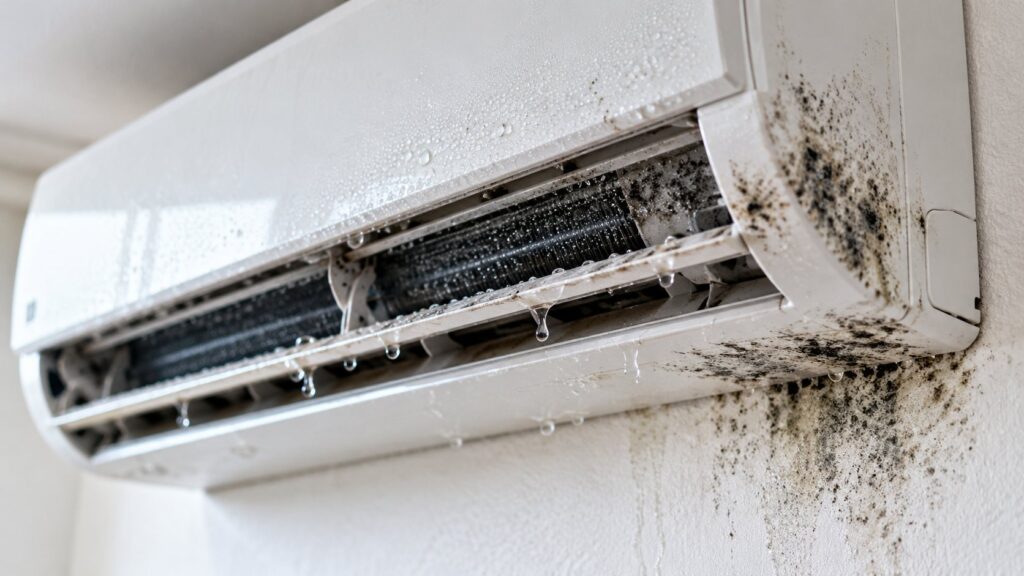
You clean the AC.
The musty smell disappears.
A few weeks later, it comes back.
Why?
Because sometimes the real problem is not dirt.
It is moisture.
Air-conditioning systems naturally produce condensation. Under normal conditions, that water is collected and safely drained away.
But when humidity, condensation, drainage or insulation problems allow parts of the HVAC system to remain damp, conditions can develop that support mold and other microbial growth.
That is why simply cleaning or disinfecting an AC system may not permanently solve a recurring contamination problem.
The moisture source must also be identified.
At AirCare Pro, our principle is simple:
Diagnose Before We Treat.
Why Does an AC Produce Water?
Air conditioners do two important things:
They cool the air and remove moisture from it.
Warm indoor air passes across the cold evaporator coil.
When the coil temperature is below the dew point of the surrounding air, moisture condenses on the cold surface—similar to the water droplets that form on the outside of a cold bottle.
This is normal.
The water should:
Condense on the coil → Flow into the drain pan → Enter the condensate line → Drain safely away
Problems begin when this process does not work correctly.
What Is Humidity?
Humidity describes the amount of moisture present in the air.
You will commonly see it expressed as Relative Humidity (RH).
When indoor humidity becomes excessive, moisture-related problems become more likely.
EPA recommends keeping indoor relative humidity below 60% where possible, with approximately 30–50% described as an ideal range.
But humidity is only part of the story.
The temperature of surfaces also matters.
What Is Condensation?
Condensation occurs when warm, humid air contacts a sufficiently cold surface.
You see the same effect when taking a cold bottle from the refrigerator into warm air.
Water forms on the outside.
Inside a building, the same physical process can occur on:
- AC ducts
- Diffusers
- Chilled-water pipes
- Supply-air components
- Cold walls
- Windows
- HVAC equipment
Condensation is therefore not necessarily caused by a water leak.
Sometimes the water is coming directly from moisture in the air.
Why Is Condensation Important in HVAC Systems?
Persistent condensation can wet materials that were intended to remain dry.
Once moisture combines with dust, organic material and suitable temperatures, conditions may become favorable for microbial growth.
This can affect areas such as:
- Evaporator coils
- Drain pans
- Air-handling units
- Duct insulation
- Diffusers
- Duct surfaces
- Ceiling areas surrounding AC outlets
- Building materials near HVAC equipment
The correct solution is therefore not simply:
“Kill the mold.”
The better question is:
“Why is this area staying wet?”
7 Common HVAC Moisture Problems
1. Blocked Condensate Drain
The condensate line carries water away from the AC.
If it becomes blocked by dirt, sludge or other contamination, water can accumulate in the drain pan or overflow.
Possible signs include:
- Water leaking from the AC
- Standing water
- Wet ceilings
- Musty odors
- Repeated drainage problems
Cleaning the visible water without clearing the drainage problem will not solve the cause.
2. Dirty or Poorly Draining Drain Pan
The drain pan sits below the cooling coil and collects condensation.
If the pan contains dirt, sludge or standing water, it can become a hygiene concern.
EPA specifically recommends keeping AC drip pans clean and drain lines unobstructed and flowing properly.
Professional maintenance should therefore inspect both the pan and drainage system.
3. Damaged or Missing Duct Insulation
Cold supply ducts often travel through warmer spaces.
Insulation helps prevent the external duct surface from becoming cold enough for condensation to form.
If insulation is:
- Missing
- Damaged
- Compressed
- Poorly installed
- Wet
- Discontinuous
warm humid air may reach the cold duct surface.
Condensation can then develop.
The correct repair may involve insulation or vapor-barrier correction, not duct cleaning.
4. High Indoor Humidity
An AC may be cooling the room while humidity remains too high.
This can happen for several reasons, including:
- High outdoor humidity
- Excessive outside-air infiltration
- Moisture-producing activities
- Ventilation problems
- Building-envelope leakage
- AC operation or control issues
- Equipment that is not effectively removing the moisture load
High humidity increases the likelihood of condensation on sufficiently cold surfaces.
This is particularly important in humid coastal environments.
5. Water Leakage
Not every HVAC moisture problem is condensation.
Water may enter from:
- Plumbing leaks
- Roof leaks
- Building-envelope leaks
- Drainage failures
- Equipment leaks
- Other sources
The origin of the water should be identified before remediation begins.
Cleaning mold without repairing the leak creates a high risk of recurrence.
6. Wet HVAC Insulation
Insulation inside or around HVAC systems can sometimes become wet because of condensation or water intrusion.
This requires careful assessment.
Some porous materials that become heavily contaminated may not be effectively restored through ordinary cleaning.
Replacement may be necessary depending on the material and condition.
The moisture source must also be corrected before new insulation is installed.
7. Poor AC Maintenance
Neglected HVAC systems can develop combinations of:
Dirty Coils + Contaminated Drain Pans + Blocked Drainage + Poor Airflow + Moisture
That is why preventive maintenance is also an indoor-air-hygiene issue.
Maintaining filters, coils and drainage can help reduce conditions that support contamination.
Why Can Mold Return After AC Cleaning?
This is one of the most important questions in HVAC hygiene.
Suppose microbial contamination is cleaned from an AC component.
But the underlying drainage problem remains.
Water continues accumulating.
The area becomes damp again.
Contamination can return.
This is why AirCare Pro follows this principle:
Remove the contamination AND correct the condition that allowed it to develop.
Otherwise, cleaning may address the symptom rather than the cause.
Can Disinfectant Prevent Mold From Returning?
Not by itself.
A disinfectant or antimicrobial treatment does not repair:
- A blocked drain
- Damaged insulation
- High humidity
- A leaking pipe
- Condensation
- A roof leak
- Poor airflow
- Standing water
Chemical treatment may be appropriate in certain situations, but it should not replace physical cleaning or moisture correction.
A better process is:
Inspect → Identify Moisture Source → Correct Moisture → Physically Clean → Treat When Appropriate → Verify
Does Mold Always Mean the Ducts Need Cleaning?
No.
The contamination may be located somewhere else in the HVAC system.
For example:
Evaporator Coil
Drain Pan
AHU
Insulation
Diffuser
Ceiling Area
Condensate Drain
Ductwork
Before recommending complete duct cleaning, the actual source and extent of contamination should be determined.
If the problem is a blocked drain pan beneath the evaporator coil, cleaning hundreds of meters of ductwork may not address the root cause.
What If Mold Is Inside Insulated Ductwork?
This deserves particular attention.
Porous HVAC insulation is different from bare sheet-metal ductwork.
When porous insulation becomes wet and significantly mold-contaminated, cleaning may not always be effective.
EPA guidance indicates that wet or mold-contaminated internal duct insulation may require removal and replacement.
The system should be properly assessed before deciding whether cleaning or replacement is appropriate.
Can You Just Spray the AC With Disinfectant?
This is one of the practices AirCare Pro wants customers to understand correctly.
Imagine a surface covered with:
Dust + Moisture + Microbial Contamination
Spraying a chemical over that contamination does not physically remove the accumulated material.
Professional HVAC hygiene should prioritize:
Source Removal
Physical contamination should be removed.
Moisture problems should be corrected.
Treatment can then be considered where appropriate.
Cleaning comes before unnecessary chemical application.
What Indoor Humidity Should I Aim For?
EPA recommends maintaining indoor relative humidity below approximately 60%, ideally around 30–50% where practical.
However, humidity targets should always be considered alongside:
- Climate
- Building design
- HVAC design
- Occupancy
- Temperature
- Condensation risk
ASHRAE also emphasizes that condensation risk depends on the relationship between air dew point and surface temperature.
In other words, simply reading the room’s humidity percentage does not tell the entire story.
What Is Dew Point?
Dew point is the temperature at which moisture in the air begins to condense.
This is extremely important in HVAC systems.
For example:
If humid air enters a ceiling void and contacts a cold supply duct whose surface temperature is below the air’s dew point, condensation can form.
That is why HVAC professionals need to think about:
Temperature + Humidity + Dew Point + Surface Temperature + Insulation
—not humidity alone.
Why Do AC Diffusers Sometimes “Sweat”?
Water droplets around an AC diffuser can indicate condensation.
Possible causes include:
- High humidity
- Cold supply-air temperature
- Insulation problems
- Air leakage around the diffuser
- Unconditioned air entering the ceiling void
- Building-envelope leakage
- Other installation issues
The correct solution depends on the cause.
Simply wiping away the water will not prevent it from returning.
Why Are Coastal Areas More Vulnerable?
Locations with warm, humid outdoor air can create demanding moisture-control conditions.
When humid outdoor air enters a cooled building through:
- Doors
- Building leakage
- Ventilation
- Ceiling spaces
- Poorly sealed penetrations
it may encounter cold HVAC surfaces.
This increases condensation risk.
Buildings in humid environments therefore require particular attention to:
Insulation + Air Sealing + Drainage + HVAC Operation + Humidity Control
Can Setting the AC Extremely Cold Cause Condensation?
It can contribute under certain conditions.
Lower surface temperatures increase the chance that a surface will fall below the dew point of surrounding humid air.
However, a condensation problem should not automatically be blamed on the thermostat.
The complete situation should be assessed, including:
- Indoor humidity
- Outdoor humidity
- Insulation
- Air leakage
- Supply-air temperature
- Duct surface temperature
- HVAC design
- Building conditions
Again:
Diagnose Before We Treat.
How Can HVAC Mold Problems Be Prevented?
There is no single solution.
Effective prevention requires moisture management.
Important measures include:
Keep Drainage Clear
Condensate should flow freely from the AC.
Keep Drain Pans Clean
Standing water should not remain unnecessarily inside the HVAC system.
Maintain Coils
Dirty coils and surrounding components should be inspected and cleaned when required.
Maintain Filters
Correct filtration helps reduce contamination entering HVAC components.
Inspect Duct Insulation
Damaged or wet insulation should be investigated.
Control Water Leaks
Roof, plumbing and building-envelope leaks should be repaired promptly.
Control Humidity
Indoor moisture levels should be monitored where humidity problems are suspected.
Investigate Condensation
Repeated sweating around ducts, diffusers or pipes should not be ignored.
Perform Preventive HVAC Maintenance
Regular inspection can identify moisture problems before they develop into larger contamination issues.
Do I Need Mold Testing?
Not necessarily.
If visible contamination and a clear moisture source are present, the priority is often to identify and correct the moisture problem and properly remediate the affected area.
Testing can be useful in certain specialized investigations, but it should have a clear purpose.
A laboratory report does not repair a blocked drain or leaking pipe.
The AirCare Pro Moisture Investigation
When a customer reports repeated mold, condensation or musty odors, our objective is not simply to spray the AC.
We investigate the system.
Our process follows:
1. Inspect
Identify visible contamination, water and affected HVAC components.
2. Identify the Moisture Source
Determine whether moisture is coming from condensation, drainage, leakage, humidity or another source.
3. Correct the Cause
Address the underlying condition where it falls within the agreed scope.
4. Remove Contamination
Clean affected HVAC components using appropriate methods.
5. Treat When Appropriate
Apply suitable microbial treatment only where technically justified.
6. Verify
Inspect the affected area following the work.
7. Recommend Prevention
Advise the customer on maintenance, drainage, insulation, humidity or other corrective measures where required.
Cleaning Without Moisture Control Is Only Half the Job
When mold repeatedly returns inside an HVAC system, asking:
“What chemical should we use?”
may be the wrong first question.
Ask instead:
Where is the moisture coming from?
Once the moisture source is understood, the correct solution becomes much clearer.
For professional AC maintenance, moisture investigation, AC duct cleaning, coil and AHU cleaning, mold treatment and indoor air hygiene services in Saudi Arabia, contact AirCare Pro.
Diagnose Before We Treat.
AirCare Pro — Breathe Pure. Live Safe.