When an air conditioner is not cooling properly, many people immediately suspect the refrigerant or compressor.
But one of the first areas that should be inspected is much simpler:
The AC coils.
Your air-conditioning system relies on clean heat-transfer surfaces to remove heat from indoors and release it outside. When these surfaces become covered with dust, dirt and other contamination, the AC may have to work harder to achieve the required cooling.
The indoor evaporator coil is also particularly important from an HVAC hygiene perspective because it operates in a naturally moist environment.
Understanding what AC coils do—and why they need maintenance—can help prevent cooling problems, unnecessary energy consumption and contamination.
What Are the Two Main AC Coils?
Most air-conditioning systems contain two important heat-transfer coils.
Evaporator Coil
The evaporator coil is located on the indoor side of the system.
Warm indoor air passes across the cold coil. Refrigerant inside the coil absorbs heat from the air, while moisture in the air can condense on the coil surface.
The cooled air is then circulated back into the building.
Condenser Coil
The condenser coil is normally located in the outdoor unit.
Its job is essentially the opposite: it releases the heat collected from inside the building to the outdoor environment.
Both coils need adequate airflow and reasonably clean surfaces to perform effectively.
What Happens When AC Coils Become Dirty?
Imagine covering a heat exchanger with a layer of dust.
The equipment may still operate—but heat transfer becomes more difficult.
Dirty coils can contribute to:
- Reduced cooling performance
- Longer AC operating times
- Increased energy consumption
- Reduced heat-transfer efficiency
- Higher operating stress on the system
- Poor airflow
- Ice formation under certain operating conditions
- Premature equipment problems
Cleaning the coils is therefore not simply cosmetic maintenance.
It is part of maintaining the AC’s ability to transfer heat efficiently.
Why Does the Evaporator Coil Get Dirty?
Air passes across the evaporator coil every time the AC operates.
The filter is designed to capture airborne particles before they reach the coil, but filtration is never perfect.
Contamination can accumulate more quickly when:
- Filters are dirty
- Filters are missing
- Filters do not fit correctly
- Air bypasses the filter
- The building has high dust levels
- Construction or renovation is taking place
- Maintenance has been neglected
- The AC operates for long periods
Saudi Arabia’s dusty environment and long cooling season make regular inspection particularly important.
Why Is the Evaporator Coil Important for Indoor Air Hygiene?
The evaporator coil is different from many other AC components because it frequently becomes wet during normal operation.
As warm air passes over the cold coil, moisture condenses from the air.
That water should move from the coil into the condensate drain pan and then safely through the drainage system.
Problems can develop when moisture combines with accumulated dirt and poor drainage.
The result can be conditions favorable to microbial contamination.
This is why professional HVAC hygiene should consider the:
Coil + Drain Pan + Condensate Line + Blower + Airflow
as interconnected parts of the system.
Can a Dirty Coil Cause a Bad AC Smell?
It can contribute.
If dirt, moisture and microbial contamination accumulate around the evaporator coil or drain pan, occupants may notice musty or unpleasant odors when the AC operates.
However, odor alone does not prove that the coil is responsible.
Other potential sources include:
- Drain pans
- Condensate lines
- Air filters
- Blower sections
- Ductwork
- Wet insulation
- Building drainage
- Other indoor sources
A professional inspection should identify the source before treatment is recommended.
Can Dirty Coils Affect Cooling?
Yes.
The evaporator coil needs effective contact with moving air to absorb heat.
Accumulated dirt can interfere with both airflow and heat transfer.
Likewise, a heavily contaminated outdoor condenser coil can have difficulty releasing heat efficiently.
If your AC runs for long periods but struggles to achieve the thermostat setting, coil condition should be one of several items inspected.
Other possible causes include refrigerant problems, dirty filters, fan problems, airflow restrictions, thermostat faults and mechanical issues.
Does Coil Cleaning Reduce Electricity Consumption?
Cleaning a dirty coil can help restore heat-transfer performance and reduce unnecessary operating time.
However, it is important not to make unrealistic promises.
Cleaning a coil does not automatically guarantee a specific percentage reduction in your electricity bill.
Energy consumption also depends on:
- Outdoor temperature
- Thermostat setting
- Building insulation
- Equipment condition
- AC efficiency
- Occupancy
- Air leakage
- System operating hours
Professional maintenance should focus on restoring the AC to proper operating condition rather than promising an arbitrary energy-saving percentage.
How Often Should AC Coils Be Cleaned?
There is no single cleaning interval appropriate for every AC system.
The correct frequency depends on factors such as:
- Operating hours
- Environmental dust
- Filter condition
- Building use
- Equipment location
- Maintenance history
- Construction activity
- Manufacturer recommendations
For AC systems operating heavily in Saudi Arabia, periodic inspection is particularly important.
Inspect first. Clean when required.
This is more professional than cleaning components unnecessarily according to an arbitrary timetable.
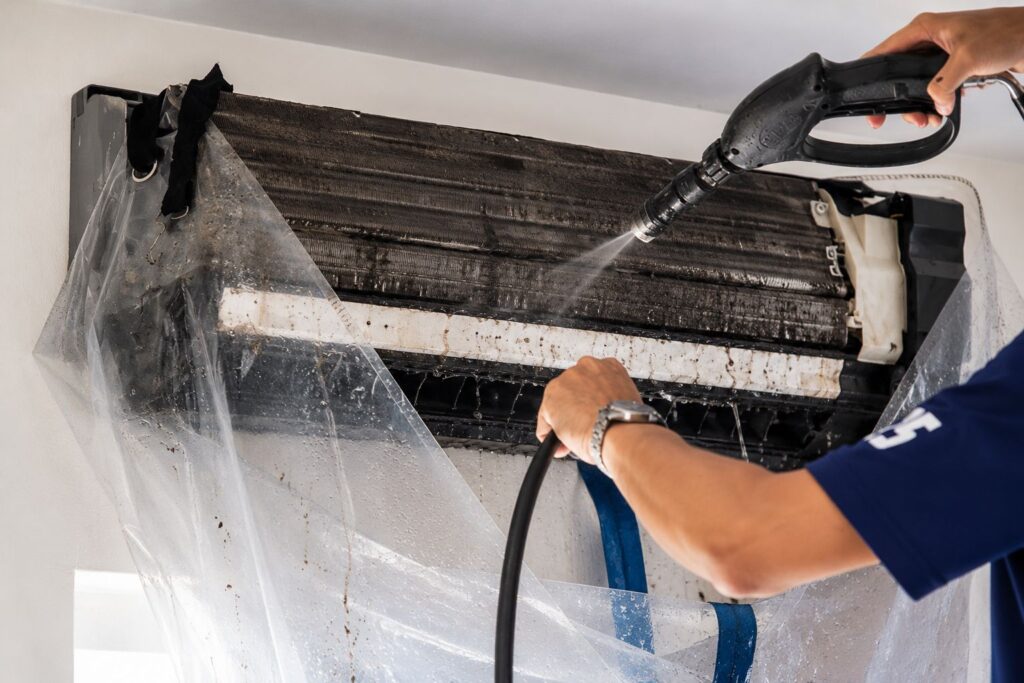
What Does Professional Evaporator Coil Cleaning Involve?
The exact method depends on the equipment and the level of contamination.
A professional service may involve:
1. Inspection
The technician assesses the coil, filter, blower, drain pan and surrounding components.
2. Safe Isolation
The equipment is safely isolated before work begins.
3. Access
Panels or service openings are removed as required to reach the coil properly.
4. Contamination Removal
Loose dust and debris are removed using appropriate equipment and methods.
5. Coil Cleaning
The coil is cleaned using a method suitable for the coil construction and condition.
Care must be taken not to damage delicate coil fins.
6. Drain Pan Cleaning
Accumulated dirt, sludge and contamination should be removed from the condensate pan where required.
7. Drainage Inspection
The condensate drain should be checked to ensure that water can drain correctly.
8. Reassembly and Testing
The system is reassembled and operated to confirm normal function.
Should Chemicals Be Used on AC Coils?
The cleaning method should be selected according to the coil condition and manufacturer requirements.
Where a cleaning chemical is necessary, it should be:
- Suitable for HVAC coil cleaning
- Compatible with the coil material
- Used at the correct concentration
- Applied according to the manufacturer’s instructions
- Properly rinsed where the product requires rinsing
Using unnecessarily aggressive chemicals can damage coil surfaces and surrounding components.
More chemical does not mean better cleaning.
What About Mold or Bacteria on the Coil?
Where suspected microbial contamination is present, the problem should be approached systematically.
The objective should be to:
Identify → Clean → Control Moisture → Correct Drainage → Treat Where Appropriate → Verify
Simply spraying disinfectant over a dirty coil is not equivalent to proper cleaning.
Physical contamination should be removed, and the moisture or drainage conditions contributing to the problem should be corrected.
What Is the Difference Between Coil Cleaning and Duct Cleaning?
They are different services.
Coil cleaning focuses on the heat-transfer surfaces and associated components of the AC equipment.
Duct cleaning focuses on removing contamination from the supply and return air-distribution system and other affected HVAC components.
Sometimes only the coil requires cleaning.
Sometimes the ductwork is contaminated.
Sometimes the entire HVAC system requires attention.
This is why inspection should come