When people hear “AC duct cleaning,” they often imagine a technician removing the air vents, vacuuming around the openings and putting them back.
Professional AC duct cleaning is much more than that.
A ducted HVAC system can include supply and return ducts, grilles and diffusers, air-handling units, fans, coils, drain pans and other components that come into contact with the air circulating through the building.
Proper HVAC cleaning therefore starts with understanding the system, assessing its condition and selecting the correct cleaning method.
Here is what you should expect from a professional AC duct cleaning service.
Step 1: Inspect the HVAC System
Professional duct cleaning should begin with an inspection, not immediately with cleaning.
The technician should assess the condition and accessibility of the HVAC system and look for issues such as:
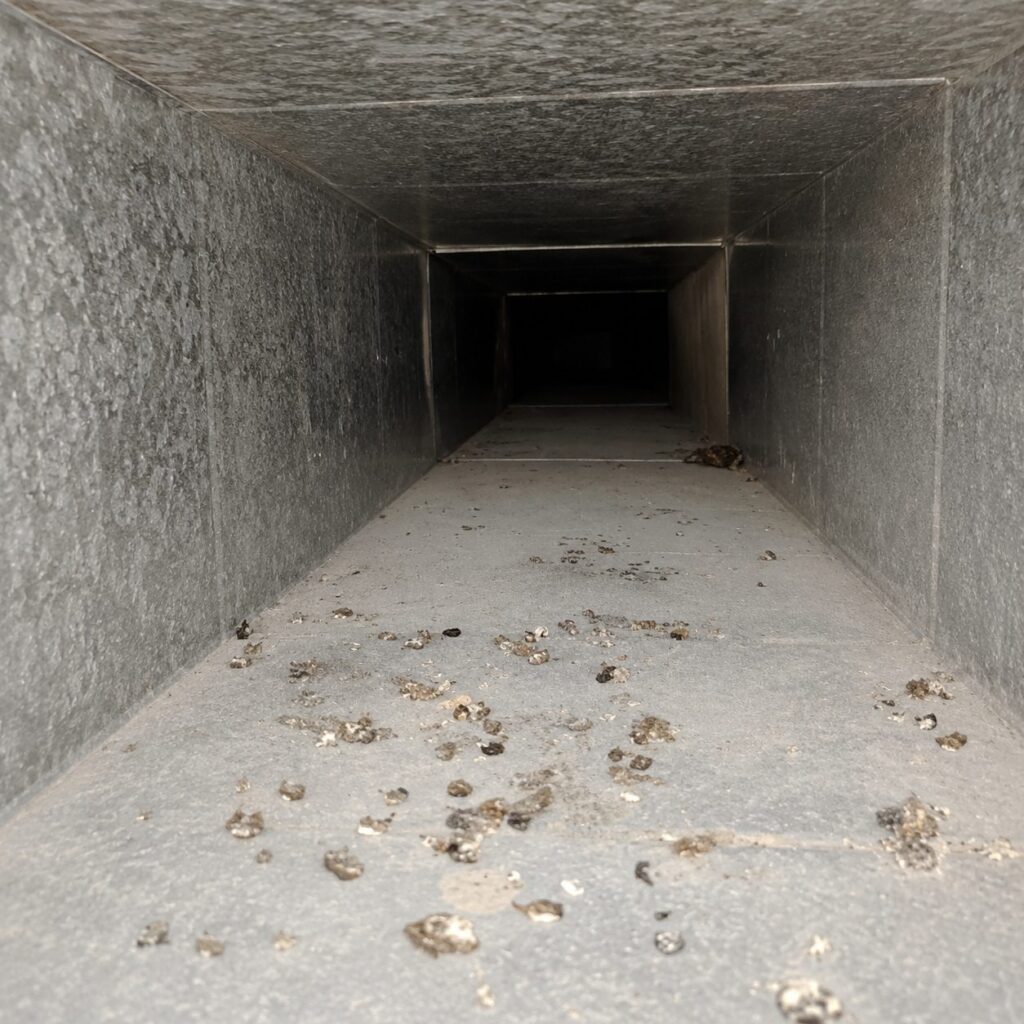
- Dust and debris accumulation
- Construction contamination
- Moisture or condensation
- Suspected microbial growth
- Dirty coils or drain pans
- Damaged or contaminated insulation
- Pest contamination
- Restricted or inaccessible duct sections
The inspection helps determine what actually requires cleaning and which cleaning methods are appropriate.
It can also identify maintenance problems that cleaning alone will not solve.
Step 2: Protect the Property and Prepare the Work Area
Before cleaning begins, the work area should be properly prepared.
Furniture, finishes and occupied areas should be protected where necessary, and the cleaning process should be arranged to prevent removed contamination from spreading into the building.
For commercial and industrial projects, additional containment and safety controls may be required depending on the building, HVAC system and type of contamination.
Professional duct cleaning is not only about removing dirt—it is also about controlling that dirt during the cleaning process.
Step 3: Establish Proper Access to the Ductwork
Technicians need adequate access to clean the internal surfaces of the HVAC system.
Existing openings such as diffusers, return grilles and service openings may be used where suitable.
For larger or more complex duct systems, additional access openings may be required so that cleaning equipment can properly reach the internal duct surfaces.
These openings should be created carefully without compromising the integrity of the ductwork and should be professionally closed and sealed after the work is completed.
If a contractor cannot properly access the duct, it is reasonable to ask:
How are they cleaning the areas their equipment cannot reach?
Step 4: Place the System Under Negative Pressure
One of the most important parts of professional duct cleaning is negative-pressure vacuum collection.
A powerful vacuum collection system is connected to the HVAC system to create negative pressure during cleaning.
Why is this important?
When brushes, air tools or other agitation equipment loosen accumulated contamination, dust and debris become airborne inside the duct.
Negative pressure helps direct these loosened contaminants toward the collection equipment rather than allowing them to escape into occupied areas.
In simple terms:
Agitation loosens the contamination.
Negative pressure controls it.
Vacuum collection removes it.
Step 5: Mechanically Dislodge Dust and Debris
Once appropriate containment and vacuum collection are established, technicians use specialized tools to physically dislodge contamination from the internal duct surfaces.
Depending on the duct material and condition, these tools may include:
- Rotary brushes
- Air whips
- Compressed-air nozzles
- Specialized agitation tools
- Contact vacuum equipment
- Manual brushing for specific components
The cleaning method must be appropriate for the duct construction.
For example, aggressive cleaning methods that may be suitable for some metal ducts may damage flexible ducts or internally insulated ductwork.
Professional cleaning is therefore not simply about using the strongest machine available—it is about using the correct equipment and technique for the system being cleaned.
Step 6: Capture and Remove the Contamination
As contamination is loosened, the vacuum collection system captures and removes the debris from the HVAC system.
This is known as source removal.
The objective is to physically remove accumulated contamination rather than merely move it from one part of the system to another.
Simply blowing compressed air through ducts without effective collection and containment is not the same as professional source-removal cleaning.
Step 7: Clean Relevant HVAC Components
A common mistake is to think that HVAC cleaning means cleaning only the ducts.
It does not.
Depending on the condition and agreed scope of work, attention may also be required for components such as:
- Supply and return ducts
- Grilles and diffusers
- Air-handling units
- Fan and blower sections
- Cooling coils
- Condensate drain pans
- Plenums
- Dampers
- Other accessible air-side components
Why does this matter?
If heavily contaminated components are left untouched, they may contribute to recontamination of cleaned sections of the HVAC system.
The system should therefore be considered as a whole rather than as a collection of isolated air vents.
Step 8: Inspect Coils, Drain Pans and Moisture Conditions
Cleaning is also an opportunity to identify HVAC maintenance issues.
Cooling coils and condensate drain pans are particularly important because they operate in areas where moisture is naturally present.
A technician should look for issues such as:
- Dirty evaporator coils
- Standing water
- Blocked condensate drains
- Corrosion
- Excessive condensation
- Water leakage
- Suspected microbial contamination
If moisture problems are identified, the underlying cause should be corrected.
Cleaning contamination without addressing the moisture that caused it may allow the problem to return.
Step 9: What About Mold, Bacteria and Disinfection?
Not every duct cleaning project requires chemical treatment.
Where suspected microbial contamination is present, the first priorities are to identify the affected area, understand the moisture source and physically remove contamination where appropriate.
Antimicrobial or disinfectant treatment should not be used as a substitute for proper cleaning.
Where treatment is appropriate, the selected product must be suitable for the intended HVAC application and used according to its approved instructions.
AirCare Pro therefore approaches microbial treatment as an additional technical measure when justified—not as something automatically sprayed into every AC system.
Step 10: Close and Seal Access Openings
Any service openings created during cleaning should be properly closed after the work is completed.
The closure should maintain the structural and functional integrity of the duct system and minimize air leakage.
Access openings should not simply be left poorly covered or sealed temporarily with ordinary tape.
Correct access and reinstatement are part of professional HVAC cleaning.
Step 11: Verify the Cleaning
How do you know the ducts are actually clean?
Verification matters.
After cleaning, accessible components should be inspected to confirm that visible contamination has been removed.
Depending on the project requirements, verification may include:
- Visual inspection
- Before-and-after photographs
- Internal duct photography or video
- Surface cleanliness assessment
- Formal cleanliness verification methods where specified
For commercial and industrial projects, documentation can also form an important part of project closeout.
A professional contractor should be able to demonstrate what was cleaned—not simply tell the customer that the work is finished.
What Should Professional Duct Cleaning NOT Look Like?
Be cautious if a service consists only of:
Removing the vent covers → vacuuming around the openings → spraying fragrance or chemical → reinstalling the covers.
That is not equivalent to comprehensive HVAC duct cleaning.
Proper cleaning requires appropriate access, contamination removal, collection and verification.
Likewise, customers should be cautious of contractors making unrealistic promises such as:
“Duct cleaning eliminates all bacteria.”
“Cleaning your ducts will cure allergies.”
“Every AC system must be disinfected.”
“Your ducts must be cleaned every year.”
Professional HVAC hygiene should be based on the actual condition of the system, not fear-based selling.
How Long Does AC Duct Cleaning Take?
There is no single answer.
The duration depends on factors including:
- Size of the HVAC system
- Length and configuration of the ductwork
- Number of AC units
- Accessibility
- Type and level of contamination
- Duct construction
- Number of technicians
- Building occupancy and access restrictions
- Whether coils, AHUs or other components are included
- Whether additional treatment or corrective work is required
A proper assessment should therefore come before promising an exact cleaning duration.
Residential vs. Commercial Duct Cleaning
The basic principles are similar, but the scale can be very different.
A residential villa may have several split-ducted units serving individual zones.
Commercial properties can contain large AHUs, extensive supply and return networks, VAV boxes and multiple floors or zones.
Industrial facilities may add further requirements involving permits, work-at-height controls, confined spaces, contamination control and operational restrictions.
The equipment, manpower and cleaning strategy should therefore be selected specifically for the system and facility.
Why NADCA Standards Matter
Professional HVAC cleaning should be based on recognized industry practices rather than improvised cleaning methods.
NADCA—The HVAC Inspection, Cleaning and Restoration Association—publishes ACR, The NADCA Standard for Assessment, Cleaning and Restoration of HVAC Systems.
The standard provides an industry framework covering HVAC assessment, cleaning procedures, contamination control, equipment use, system access and cleanliness verification.
For customers, this provides an important benchmark when evaluating how HVAC cleaning should be performed.
The AirCare Pro Approach
At AirCare Pro, our objective is not simply to make the air vents look clean.
We approach HVAC hygiene as a complete process:
Inspect → Protect → Access → Create Negative Pressure → Agitate → Extract → Clean Components → Verify → Document
Our services combine:
AC Maintenance
Keeping critical AC components clean, functional and properly maintained.
AC Duct Cleaning
Professional source-removal cleaning of contaminated HVAC duct systems.
Indoor Air Hygiene
Assessment and treatment of contamination, moisture-related issues and microbial concerns where appropriate.
Our duct-cleaning approach follows recognized industry practices and NADCA principles, with professional equipment and trained personnel.
Thinking About Having Your AC Ducts Cleaned?
Do not choose a duct-cleaning company based only on price.
Ask how they will access the ductwork, what equipment they will use, how they will control airborne contamination, which HVAC components are included and how they will demonstrate that the system is clean after the work.
A professional company should be able to answer those questions clearly.
For professional AC maintenance, AC duct cleaning and indoor air hygiene services in Saudi Arabia, contact AirCare Pro to arrange an assessment.
AirCare Pro — Breathe Pure. Live Safe.