
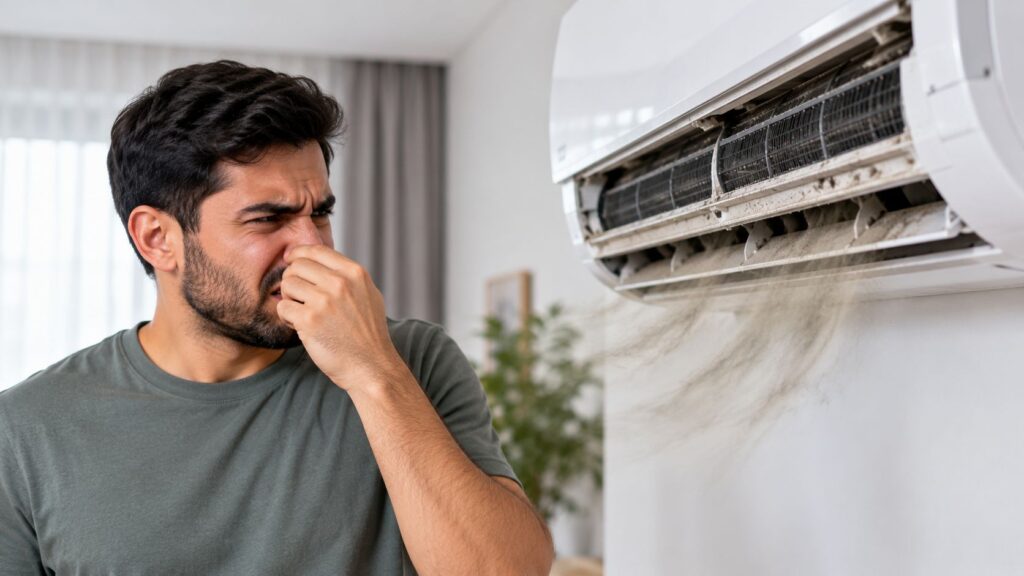
You turn on the air conditioner expecting fresh, cool air—but instead notice a musty, sour or unpleasant smell coming from the vents.
Should you be concerned?
An unusual AC odor should not automatically be blamed on dirty ducts. The source could be anywhere from the air filter and cooling coil to the condensate drain, air-handling unit, ductwork or an electrical component.
The type of smell—and when it occurs—can provide useful clues.
Here are seven common AC odors, what may be causing them and when professional inspection is recommended.
1. Musty or Damp Smell
A musty or damp odor is one of the most common complaints associated with air-conditioning systems.
Because an AC system cools and dehumidifies air, moisture naturally forms around the evaporator coil and condensate system.
Problems can develop when moisture remains where it should not.
Possible causes include:
- Dirty evaporator coils
- Standing water in the drain pan
- Blocked condensate drainage
- Excessive indoor humidity
- Wet duct insulation
- Condensation inside or around ductwork
- Microbial growth on HVAC components
A musty smell does not automatically prove that mold is present. However, it is a good reason to inspect the system for moisture and contamination.
Simply spraying fragrance into the AC does not correct the cause.
2. Sour or “Dirty Sock” Smell
Some AC systems develop an unpleasant sour odor that people sometimes describe as smelling like dirty socks.
This type of odor may be associated with contamination on the evaporator coil, drain pan or nearby HVAC components, particularly where moisture is repeatedly present.
The correct response is not simply to spray disinfectant through the vents.
The system should be inspected to determine:
Where is the odor originating?
Is the coil contaminated?
Is the drain pan clean and draining correctly?
Is excessive moisture present?
Once the source is identified, the affected components can be properly cleaned and the underlying moisture condition corrected.
3. Moldy or Earthy Smell
A strong moldy or earthy smell deserves attention.
Mold requires moisture to grow, which means the most important question is not simply:
“How do we kill the mold?”
It is:
“Why is moisture present here?”
Possible sources include condensation, blocked drainage, water leakage, excessive humidity or wet insulation.
If suspected microbial contamination is discovered, both the contamination and its moisture source need to be addressed.
Otherwise, the problem may return after cleaning.
4. Burning or Electrical Smell
A burning, overheated-plastic or electrical odor should be treated differently from an ordinary cleanliness problem.
Possible causes can include electrical components, wiring, motors, capacitors or other overheating parts.
If you notice a strong or persistent burning smell, switch off the AC and arrange professional inspection promptly.
Do not assume that an electrical odor will be solved by duct cleaning.
This is an AC maintenance and safety issue that requires proper diagnosis.
5. Dusty Smell When the AC Starts
A temporary dusty smell can sometimes occur when an AC system has been unused for a period and accumulated dust is disturbed when it starts operating.
If the smell persists, however, the system may need inspection.
Possible areas to check include:
- Air filters
- Evaporator coil
- Blower section
- Return-air areas
- Supply and return ductwork
- Grilles and diffusers
Visible dust on a vent alone does not necessarily mean that the entire duct system requires cleaning.
Professional assessment should determine whether contamination is limited to accessible components or extends further into the HVAC system.
6. Sewage or Drain-Like Smell
A sewage-like or drain odor should be investigated rather than assumed to originate from the AC itself.
Building drainage, plumbing traps, nearby floor drains, wastewater systems or other building services may sometimes be responsible.
Because HVAC systems move air throughout a building, they can sometimes distribute an odor whose original source is elsewhere.
The first step should therefore be identifying the actual source rather than automatically cleaning or disinfecting the ducts.
7. Chemical or Unusual Odor
Chemical-type odors can originate from many sources, including cleaning products, maintenance chemicals, renovation materials, nearby activities or HVAC-related issues.
The timing of the smell can provide useful information.
Ask:
- Did it start immediately after AC maintenance?
- Was the building recently painted or renovated?
- Were chemicals recently used nearby?
- Does the odor appear only when the AC operates?
- Is it coming from one vent or throughout the building?
Persistent or unexplained chemical odors should be investigated rather than covered with air fresheners.
Why Does the Smell Become Stronger When the AC Turns On?
This does not necessarily mean that the ductwork itself is the source.
An HVAC system circulates air throughout the occupied space. If an odor originates from the air-handling unit, coil, drain pan, ductwork—or even another area from which return air is being drawn—the airflow can distribute that odor through the building.
This is why proper diagnosis is important.
Finding the source comes before choosing the treatment.
Is a Bad AC Smell Always Caused by Dirty Ducts?
No.
This is an important distinction.
A bad smell could originate from:
Filter → Coil → Drain Pan → Condensate Line → Blower → AHU → Ductwork → Building Environment
Professional technicians should investigate these potential sources rather than automatically recommending duct cleaning.
If the ducts are contaminated, they can be cleaned.
If the problem is a blocked drain, the drain needs attention.
If the coil is dirty, the coil should be cleaned.
If there is an electrical problem, it requires AC repair.
The treatment should match the cause.
Can I Solve the Problem by Spraying Disinfectant Into the AC?
Not necessarily—and this should not be the first response.
Chemical treatment is not a substitute for physical cleaning, maintenance or moisture correction.
If a drain pan contains contamination, it needs appropriate cleaning.
If a coil is dirty, the coil needs to be cleaned.
If the ductwork contains significant contamination, the affected HVAC components should be professionally cleaned.
If microbial contamination is present, the moisture conditions supporting that growth also need to be corrected.
Any antimicrobial or disinfectant treatment should be suitable for its intended application and used according to the product’s approved instructions.
How Can I Prevent AC Odors?
Good preventive maintenance can reduce many common HVAC odor problems.
Keep Filters Clean
Dirty filters can restrict airflow and allow more contamination to accumulate within the HVAC system.
Filters should be inspected regularly and cleaned or replaced according to their type, condition and manufacturer recommendations.
Keep Cooling Coils Clean
The evaporator coil is both a heat-transfer surface and an area where condensation occurs.
Keeping the coil clean helps maintain both cooling performance and HVAC cleanliness.
Maintain the Condensate Drainage System
Drain pans and condensate lines should remain clean, clear and capable of draining water correctly.
Standing water inside an HVAC system requires attention.
Control Moisture
Moisture is one of the most important factors in microbial growth.
Water leaks, excessive humidity, condensation and wet insulation should therefore be investigated and corrected promptly.
Inspect the HVAC System Periodically
Preventive inspection can identify developing problems such as dirty coils, blocked drains, deteriorated insulation and excessive contamination before they result in persistent odors or larger maintenance problems.
When Is AC Duct Cleaning the Right Solution?
Duct cleaning may be appropriate when inspection identifies significant contamination within the duct system, such as:
- Excessive accumulated dust or debris
- Particles being released from supply outlets
- Confirmed or substantial microbial contamination
- Pest contamination
- Construction or renovation debris
- Other contamination requiring professional source removal
The decision should be based on the actual condition of the system, not simply because an odor exists.
The AirCare Pro Approach: Diagnose Before We Treat
At AirCare Pro, we believe that a professional HVAC company should first determine why a problem is occurring before recommending how to treat it.
For odor complaints, our approach is:
Inspect → Identify the Source → Diagnose the Cause → Clean or Repair → Correct Moisture Issues → Treat When Appropriate → Verify
Depending on what we find, the solution may involve:
AC Maintenance
For filters, coils, drainage, blower components and mechanical issues.
AC Duct Cleaning
For significant contamination within the HVAC duct system.
Coil & AHU Cleaning
For contamination around cooling and air-handling components.
Mold & Microbial Control
Where microbial contamination and moisture conditions require specialized attention.
Preventive Maintenance
To reduce the likelihood of recurring HVAC cleanliness and performance problems.
Bad Smell Coming From Your AC?
Don’t simply mask it with fragrance.
A persistent odor is a sign that something should be investigated—even if the solution turns out to be simple.
AirCare Pro provides professional AC maintenance, AC duct cleaning and indoor air hygiene services in Saudi Arabia, helping customers identify the source of HVAC problems and apply the appropriate solution.
AirCare Pro — Breathe Pure. Live Safe.