Your AC filter may be one of the simplest components in your HVAC system—but it has an important job.
Every time your air-conditioning system operates, air moves through the system. The filter captures a portion of the airborne particles before they can circulate through the HVAC equipment and occupied space.
But not all filters are the same.
Some are primarily designed to protect HVAC equipment from larger dust particles. Others provide significantly better filtration of smaller airborne particles.
And one of the biggest mistakes is assuming:
Higher MERV = Always Better
The correct filter must balance filtration efficiency, airflow, equipment capability and maintenance requirements.
Here is what homeowners and facility managers should know.
What Does an AC Filter Actually Do?
An HVAC filter generally performs two important functions.
1. Protect the HVAC Equipment
The filter helps prevent dust and debris from accumulating on components such as:
- Evaporator coils
- Blower assemblies
- Fans
- Internal HVAC surfaces
Keeping these components cleaner can help maintain airflow and heat-transfer performance.
2. Filter Recirculated Air
Depending on its efficiency, the filter can also capture airborne particles as air passes through the HVAC system.
The effectiveness depends on the filter type, efficiency rating, installation and system operation.
What Is MERV?
MERV stands for:
Minimum Efficiency Reporting Value
It is a standardized way of describing an air filter’s ability to capture particles of different sizes.
The MERV system comes from ASHRAE Standard 52.2.
In general:
Higher MERV → Greater particle-removal efficiency
But that does not automatically mean you should install the highest MERV filter you can buy.
The HVAC system must be capable of operating correctly with the selected filter.
Understanding MERV Ratings
A simplified way of understanding common filter ranges is:
MERV 1–4
Basic filtration primarily intended to capture larger particles and protect equipment.
MERV 5–8
Improved filtration for larger particles and some smaller particles.
MERV 9–12
Higher particle-removal efficiency and commonly used in better residential and commercial filtration applications.
MERV 13–16
Higher-efficiency filtration capable of capturing significantly more small particles.
EPA recommends MERV 13 or the highest efficiency that the HVAC system can accommodate when improved particle filtration is desired.
However, compatibility must be checked.
Is MERV 13 Always the Best Choice?
Not necessarily.
MERV 13 can provide considerably better particle filtration than a low-efficiency filter, but the HVAC system must be able to handle it.
Before upgrading, consider:
- Fan capability
- Filter dimensions
- Filter surface area
- Filter thickness
- Airflow requirements
- Available static pressure
- Filter housing
- Manufacturer recommendations
A filter should never be selected based on MERV alone.
Good filtration with inadequate airflow is not good HVAC design.
Can a High-MERV Filter Reduce Airflow?
Potentially.
Every filter creates some resistance to airflow.
The actual pressure drop depends on much more than its MERV number, including:
- Filter design
- Media
- Surface area
- Thickness
- Air velocity
- Dust loading
- Installation
This is why two filters with similar MERV ratings can have different airflow characteristics.
As a filter collects dust, its resistance can also increase.
If the system cannot overcome that resistance, airflow may be reduced.
Possible consequences can include:
- Weak airflow
- Reduced cooling performance
- Longer AC operating time
- Increased fan workload
- Possible coil icing under certain conditions
The correct question is therefore not:
“What is the highest MERV available?”
It is:
“What is the highest appropriate filtration efficiency this HVAC system can support while maintaining required airflow?”
What Is a HEPA Filter?
HEPA stands for High-Efficiency Particulate Air.
True HEPA filtration provides very high particle-removal efficiency.
But a HEPA filter should not simply be installed into an ordinary AC system because “more filtration must be better.”
HEPA filters typically require systems specifically designed to accommodate their:
- Physical dimensions
- Filter housing
- Airflow requirements
- Pressure resistance
Many standard residential HVAC systems are not designed for true HEPA filters without modification.
HEPA is therefore a different filtration category—not simply a better replacement for every standard AC filter.
What About Washable AC Filters?
Many split and ductless AC systems use reusable filters.
These are primarily designed to protect the equipment from larger dust and debris.
They should be removed and cleaned according to the equipment manufacturer’s instructions.
Typical steps may include:
Remove → Inspect → Clean → Dry Completely → Reinstall Correctly
Never reinstall a wet filter unless specifically permitted by the manufacturer.
And remember:
A washable mesh filter should not automatically be assumed to provide the same fine-particle filtration as a higher-efficiency pleated filter.
How Often Should AC Filters Be Cleaned?
There is no universal interval appropriate for every building.
The correct frequency depends on:
- Dust levels
- AC operating hours
- Filter type
- Outdoor conditions
- Occupancy
- Pets
- Smoking
- Construction activity
- Building use
Saudi Arabia’s dusty environment means filters can become loaded relatively quickly.
The most practical approach is:
Inspect regularly → Clean when required
Washable filters may require relatively frequent cleaning during periods of heavy AC use.
How Often Should Disposable Filters Be Replaced?
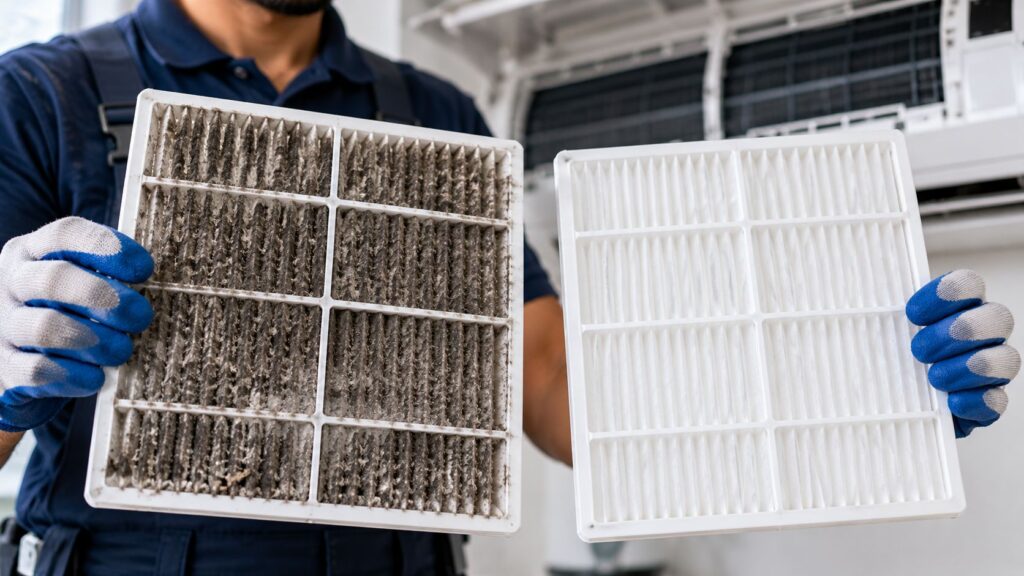
Follow the filter manufacturer’s recommendation—but also inspect the filter’s actual condition.
EPA notes that many manufacturers commonly recommend replacement approximately every 60–90 days, but filters that become heavily soiled should be changed more frequently.
In Saudi conditions, actual replacement requirements may vary significantly depending on dust exposure and operating hours.
A heavily loaded filter should not remain installed simply because the calendar says it has another month left.
What Happens If You Don’t Change a Dirty Filter?
As dust accumulates, resistance across the filter can increase.
A severely loaded filter may contribute to:
- Reduced airflow
- Poor cooling performance
- Longer operating time
- Increased stress on the blower
- Evaporator-coil problems
- Greater contamination downstream if the filter is damaged or bypassed
Ignoring filters can eventually create maintenance problems elsewhere in the system.
A relatively inexpensive component can affect much more expensive HVAC equipment.
Filter Fit Is Extremely Important
Efficiency means very little if air can simply bypass the filter.
The filter should fit properly inside its housing.
There should not be large gaps allowing air to travel around the filter instead of through it.
Think of it this way:
Air follows the easiest path.
If there is a gap beside the filter, some air may bypass the filtration media entirely.
Correct installation is therefore just as important as selecting the right filter.
Why Is My Filter Getting Dirty So Quickly?
A filter becoming dirty is not necessarily evidence of a problem.
After all, collecting particles is its job.
However, unusually rapid loading may justify investigation.
Possible contributing factors include:
- High outdoor dust
- Construction activity
- High occupancy
- Open doors or windows
- Air leakage
- Poor housekeeping
- Pets
- Return-air conditions
- Inappropriate filter selection
- Long AC operating hours
Instead of simply replacing filters more frequently, it may be useful to understand why the contamination level is unusually high.
Does a Dirty Filter Mean My Ducts Need Cleaning?
No.
A dirty filter does not automatically mean the ductwork requires professional cleaning.
Duct-cleaning decisions should be based on the actual condition of the HVAC system.
Professional duct cleaning may be appropriate where inspection identifies issues such as:
- Significant dust and debris accumulation
- Construction contamination
- Pest contamination
- Particles being released from the system
- Significant microbial contamination
- Other specific source-removal requirements
The condition of the ductwork should be inspected rather than assumed.
Will a Better Filter Eliminate Dust in My Home?
No filter can guarantee a dust-free building.
Indoor dust comes from many sources, including:
- Outdoor air
- Clothing
- Textiles
- Skin particles
- Furniture
- Construction materials
- Occupants
- Pets
- Building leakage
Better HVAC filtration can help remove airborne particles while air is passing through the system, but it does not eliminate every source of indoor dust.
Good indoor air management is broader than simply changing the filter.
Can AC Filters Remove Odors?
Standard particle filters are primarily designed to capture particles, not gases.
Some specialized filters include activated carbon or other gas-phase filtration media designed to reduce certain odors and gaseous contaminants.
But if your AC suddenly develops a strong musty, burning, sewage-like or chemical smell, simply upgrading the filter may not solve the problem.
The source should be investigated.
Does a Better Filter Improve Indoor Air Quality?
It can contribute.
Higher-efficiency filtration can remove a greater proportion of certain airborne particles when:
- The filter is correctly selected
- The system can accommodate it
- Air passes through the filter
- The filter fits properly
- The filter is maintained correctly
But indoor air quality depends on more than filtration.
It can also be affected by:
Ventilation + Outdoor Air Quality + Humidity + Moisture + Building Materials + Occupancy + Cleaning + HVAC Condition + Indoor Contaminant Sources
Filtration should therefore be considered one part of a broader indoor air quality strategy.
What Filter Should I Use in Saudi Arabia?
There is no single filter that is best for every Saudi home or commercial building.
The correct selection depends on:
Equipment + Airflow + Dust Load + Building Use + Filtration Objective
For example:
A residential split AC has very different filtration capabilities from a commercial AHU.
A hotel has different requirements from a warehouse.
A hospital has different requirements from a villa.
An office building has different requirements from an industrial facility.
Professional filter selection should therefore consider the application—not just the MERV number printed on the filter.
Commercial HVAC Filtration
Larger commercial systems often use more sophisticated filtration arrangements.
Depending on the facility and HVAC design, these may include:
- Pre-filters
- Pleated filters
- Bag filters
- Rigid filters
- Higher-efficiency final filters
- Specialized filtration systems
Some systems use multiple filtration stages.
For example:
Outdoor/Return Air → Pre-Filter → Higher-Efficiency Filter → Coil/AHU → Supply Air
The pre-filter can capture larger particles before they reach the higher-efficiency final filter, helping protect downstream components.
Filter selection should follow the HVAC design and facility requirements.
Should Filters Be Checked During AC Maintenance?
Absolutely.
Filter inspection should be one of the basic elements of preventive AC maintenance.
A technician should consider:
Filter Condition → Correct Size → Correct Installation → Air Bypass → Airflow → Equipment Condition
Simply replacing a filter without looking at the surrounding HVAC system can miss other problems.
The AirCare Pro Approach
At AirCare Pro, we don’t believe filter selection should be based on the biggest MERV number on the box.
We consider:
System Type → Filter Condition → Filtration Requirement → Airflow → Compatibility → Maintenance
Our services include:
AC Maintenance
Inspection and maintenance of filters, coils, drainage, blowers, electrical components, controls and overall AC performance.
HVAC Filtration Assessment
Assessment of filter condition, installation, suitability and maintenance requirements.
AC Duct Cleaning
Professional source-removal cleaning when inspection identifies significant contamination inside the HVAC system.
Coil & AHU Cleaning
Cleaning of contaminated air-handling components where required.
Indoor Air Hygiene
Assessment of HVAC cleanliness, moisture and other factors that may affect the indoor environment.
The Best Filter Is the Right Filter
When choosing an AC filter, remember:
Higher efficiency is useful—but only when the HVAC system can support it.
The best filter is one that:
Captures the required particles + Fits correctly + Maintains acceptable airflow + Matches the HVAC system + Is maintained properly
Before upgrading your filtration, understand what your system was designed to handle.
AirCare Pro — Breathe Pure. Live Safe.