In Saudi Arabia, air conditioning is not simply about comfort.
For much of the year, AC systems operate for long hours under demanding conditions involving high outdoor temperatures, dust, continuous operation and, in coastal areas, humidity.
That makes preventive AC maintenance particularly important.
Waiting until an air conditioner stops cooling completely can turn a manageable maintenance issue into an urgent breakdown—often when the system is under its greatest load.
So, what should professional AC maintenance actually include, and how often should it be done?
Here is what homeowners, businesses and facility managers should know.
Why Is AC Maintenance So Important in Saudi Arabia?
Air-conditioning equipment transfers heat from inside a building to the outdoor environment.
For this process to work effectively, the system depends on several components working together:
Filters → Coils → Fans → Refrigerant Circuit → Drainage → Electrical Components → Controls → Airflow
A problem with one component can affect the performance of the entire system.
Saudi operating conditions can make maintenance particularly important because AC equipment may be exposed to:
- High ambient temperatures
- Dust and airborne particles
- Long daily operating hours
- Continuous summer demand
- Humidity and condensation
- Outdoor contamination
- Heavy commercial occupancy
Preventive maintenance helps identify deterioration before it becomes a major failure.
How Often Should an AC Be Serviced?
There is no single maintenance schedule suitable for every AC system.
The correct frequency depends on:
- Equipment type
- Operating hours
- Building use
- Environmental conditions
- Dust exposure
- Manufacturer recommendations
- Previous maintenance history
- System condition
As a general baseline, annual professional maintenance is widely recommended, while systems operating heavily or in demanding environments may require more frequent inspection.
In Saudi Arabia, checking the AC before the peak cooling season is particularly sensible.
Commercial and industrial HVAC systems may require scheduled monthly, quarterly or other preventive-maintenance activities depending on equipment type and operating requirements.
The correct principle is:
Maintenance frequency should follow the equipment, operating conditions and actual system needs—not an arbitrary timetable.
What Should Professional AC Maintenance Include?
Professional maintenance should go beyond washing the filter and checking whether cold air is coming from the unit.
Depending on the equipment, a proper inspection may include the following.
1. Air Filter Inspection
The filter is one of the first lines of protection for the HVAC system.
A dirty filter can restrict airflow and allow contamination to accumulate within the equipment.
Filters should be inspected regularly and either:
Cleaned — if designed to be reusable.
or
Replaced — if disposable or no longer suitable for service.
In Saudi Arabia’s dusty conditions, filters may require attention more frequently than in less dusty environments.
2. Evaporator Coil Inspection & Cleaning
The evaporator coil absorbs heat from indoor air.
Accumulated dirt on the coil can interfere with airflow and heat transfer, potentially reducing cooling performance and increasing operating time.
The coil should therefore be inspected and cleaned when required.
Because condensation forms on the evaporator coil during normal cooling operation, its cleanliness is also important from an HVAC hygiene perspective.
3. Condenser Coil Inspection & Cleaning
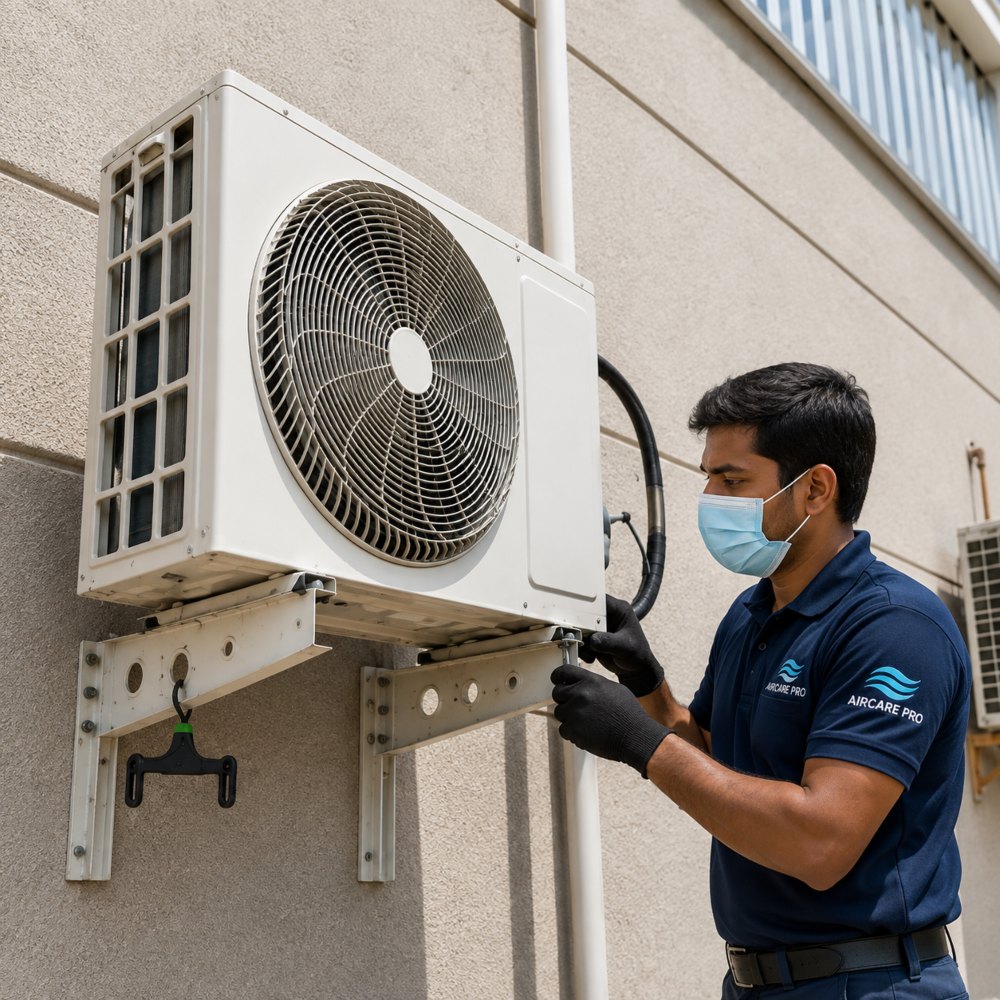
The outdoor condenser releases heat from the building.
Dust, dirt and debris on the condenser can reduce effective heat transfer.
This becomes particularly important during Saudi Arabia’s hot summer conditions, when the condenser is already operating against high outdoor temperatures.
The outdoor unit should be kept clean and provided with adequate airflow.
4. Condensate Drain & Drain Pan Inspection
Air conditioners do more than cool the air—they also remove moisture.
That moisture should collect in the drain pan and leave the system through the condensate drain.
Maintenance should check for:
- Blocked drainage
- Standing water
- Sludge or contamination
- Water leakage
- Damaged drain pans
- Incorrect drainage
A blocked condensate system can lead to water damage, odors and conditions that support microbial growth.
5. Blower & Fan Inspection
Correct airflow is essential for cooling performance.
The technician should inspect the condition and operation of relevant blower and fan components.
Problems with airflow can affect:
- Cooling
- Comfort
- Heat transfer
- Equipment performance
- Air distribution
Accumulated contamination on blower components may also require cleaning.
6. Electrical Inspection
AC systems contain motors, capacitors, contactors, controls, wiring and electrical connections.
Professional maintenance should inspect relevant electrical components for signs of:
- Loose connections
- Overheating
- Deterioration
- Abnormal operation
- Damaged wiring
- Component failure
Electrical inspection is not simply about efficiency—it is also an important part of reliable and safe AC operation.
7. Thermostat & Control Check
The thermostat tells the AC when cooling is required.
A technician should verify that the thermostat and relevant controls operate correctly and that the system starts, operates and shuts down as intended.
A control problem can sometimes appear to the customer as an AC cooling problem.
8. Refrigerant System Assessment
Refrigerant is essential to the cooling cycle, but it should not be treated as a consumable that automatically needs topping up during every service.
The refrigeration circuit should be assessed when required.
If refrigerant charge is found to be incorrect, the technician should investigate the reason rather than simply adding refrigerant repeatedly.
Possible causes may include leakage, previous incorrect servicing or another technical issue.
“Adding gas” is not preventive maintenance by itself.
9. Airflow Inspection
Good cooling requires good airflow.
A technician may inspect:
- Filter condition
- Blower performance
- Supply airflow
- Return airflow
- Diffusers and grilles
- Dampers where applicable
- Duct condition where relevant
If one room remains warm while others cool normally, the problem may be related to air distribution rather than the refrigeration equipment.
10. General System Performance
Once maintenance is completed, the AC should be operated and checked.
Depending on the system, technicians may assess:
- Cooling performance
- Airflow
- Temperature response
- Noise
- Vibration
- Drainage
- Electrical operation
- System cycling
- Overall equipment condition
The objective is not simply to clean the unit.
It is to confirm that the AC is operating correctly after service.
How Often Should AC Filters Be Cleaned in Saudi Arabia?
Filters require more frequent attention than most other AC components.
Saudi energy-efficiency guidance has recommended cleaning washable AC filters approximately every two weeks, particularly given local operating conditions.
However, the actual interval depends on the filter and environment.
A filter may require more frequent attention in:
- Dusty locations
- Homes with pets
- High-occupancy buildings
- Commercial kitchens
- Construction environments
- Facilities operating continuously
The best approach is to inspect the filter regularly and clean or replace it when required.
Should AC Coils Be Cleaned Every Service?
Not necessarily.
Cleaning should be based on their condition.
A coil that is already clean does not benefit from unnecessarily aggressive chemical treatment.
A professional technician should inspect the coil and determine whether cleaning is required.
When cleaning chemicals are used, they should be suitable for the coil material and applied according to the manufacturer’s instructions.
Professional maintenance means doing what is necessary—not automatically applying every possible treatment.
Is AC Disinfection Part of Normal Maintenance?
Not automatically.
Routine maintenance and microbial treatment are different services.
If there is evidence of microbial contamination, persistent odors, moisture problems or another hygiene concern, additional assessment may be appropriate.
The correct sequence is generally:
Inspect → Identify → Physically Clean → Correct Moisture → Treat Where Appropriate
Simply spraying disinfectant into an AC system should not be presented as a substitute for proper maintenance or cleaning.
Is AC Duct Cleaning Part of Regular AC Maintenance?
Not necessarily.
AC maintenance and duct cleaning are related, but they are different services.
AC Maintenance focuses primarily on the equipment and its operating condition.
AC Duct Cleaning addresses contamination inside the air-distribution system.
Duct cleaning should generally be recommended according to the actual condition of the ductwork, rather than automatically included in every maintenance visit.
An HVAC system can require maintenance without requiring duct cleaning—and vice versa.
What About Mold and Musty Odors?
A musty odor should be investigated.
Potential sources can include:
- Evaporator coils
- Drain pans
- Condensate lines
- Wet insulation
- Ductwork
- Air-handling units
- Excessive condensation
- Other building moisture sources
If microbial contamination is present, cleaning alone may not prevent it from returning.
The underlying moisture source must also be identified and corrected.
Residential AC Maintenance
For homes and villas, preventive maintenance should focus on maintaining cooling performance, airflow, cleanliness and reliable operation.
Depending on the AC system, attention may include:
Filters → Indoor Unit → Evaporator Coil → Drainage → Outdoor Condenser → Fans → Controls → Electrical Components
Ducted villas may also benefit from periodic inspection of the duct system, particularly where there are odor, dust, moisture or airflow concerns.
Commercial AC Maintenance
Commercial HVAC systems often operate for longer hours and serve larger numbers of occupants.
Offices, hotels, restaurants, retail facilities, schools and other commercial properties may therefore benefit from structured preventive-maintenance programs.
A commercial maintenance program can include:
- Scheduled inspections
- Filter maintenance
- Coil cleaning
- Drainage maintenance
- Electrical checks
- Airflow assessment
- Breakdown response
- Corrective maintenance
- Service documentation
- Maintenance history
Maintaining records is particularly useful for facility managers because recurring problems can be identified over time.
What Is an AC Annual Maintenance Contract?
An Annual Maintenance Contract (AMC) establishes a planned maintenance program rather than relying entirely on emergency callouts.
Depending on the agreed scope, an AMC may include:
- Scheduled preventive-maintenance visits
- AC inspection
- Filter servicing
- Coil inspection and cleaning
- Drainage checks
- Electrical inspection
- Performance testing
- Breakdown response
- Service reports
- Recommendations for corrective work
The exact scope should always be clearly defined in the contract.
For businesses and facilities with multiple AC units, an AMC can provide a more organized approach to HVAC maintenance and asset management.
Preventive Maintenance vs. Emergency Repair
There are two ways to manage an AC system.
Reactive approach:
Wait for failure → Call technician → Diagnose urgently → Repair → Resume operation.
Preventive approach:
Inspect → Maintain → Identify deterioration → Correct early → Monitor performance.
Preventive maintenance cannot eliminate every breakdown.
But it can identify many developing problems before they become emergency failures.
When Should You Call an AC Technician?
Professional attention may be required when you notice:
- Weak airflow
- Insufficient cooling
- Water leakage
- Unusual noise
- Excessive vibration
- Burning or electrical odors
- Persistent musty smells
- Ice formation
- Frequent cycling
- Unexpected shutdowns
- Uneven cooling
- Repeated circuit trips
Some of these problems can have multiple causes.
Professional diagnosis should therefore come before replacing parts or choosing a cleaning service.
The AirCare Pro Approach to AC Maintenance
At AirCare Pro, maintenance starts with understanding the condition of the equipment.
Our approach is:
Inspect → Diagnose → Maintain → Correct → Test → Document
Depending on the findings, our services can include:
AC Maintenance & Repair
Inspection, troubleshooting, preventive maintenance and corrective work for AC systems.
Coil & AC Deep Cleaning
Professional cleaning of AC components where contamination is affecting cleanliness or performance.
AC Duct Cleaning
Source-removal cleaning where inspection identifies significant contamination within the HVAC duct system.
Mold & Microbial Control
Assessment and appropriate treatment of HVAC contamination while addressing the moisture conditions contributing to the problem.
Preventive Maintenance Contracts
Planned maintenance programs for businesses and facilities requiring structured, documented HVAC maintenance.
AC Maintenance Is More Than Cleaning
A professional maintenance visit should answer three questions:
What condition is the AC in?
Is anything affecting its performance or reliability?
What needs to be done now to prevent a larger problem later?
That is the difference between simply cleaning an AC and professionally maintaining it.
For professional AC maintenance, AC repair, AC duct cleaning and indoor air hygiene services in Saudi Arabia, contact AirCare Pro to arrange an inspection or discuss a preventive-maintenance program.
AirCare Pro — Breathe Pure. Live Safe.