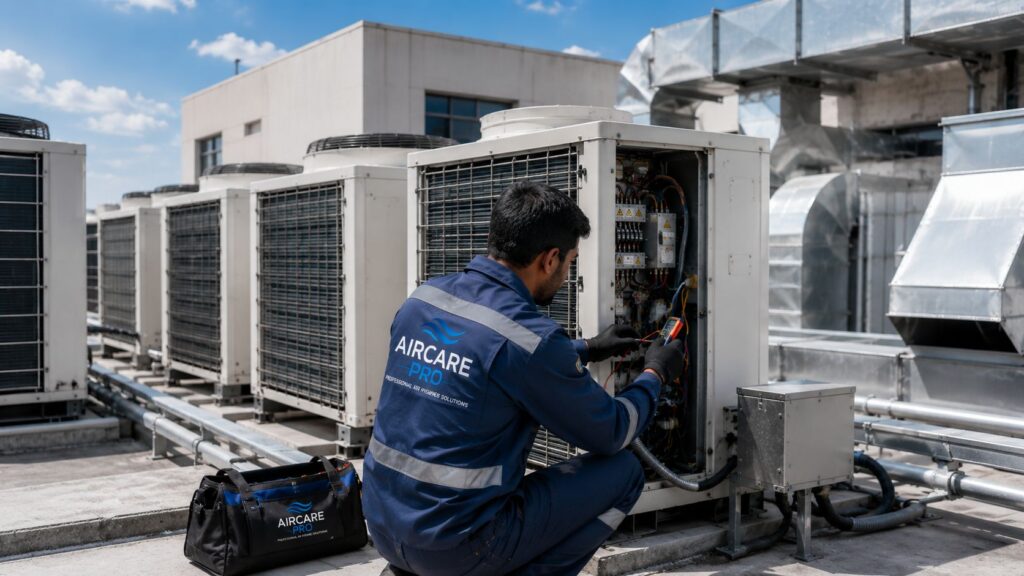
Managing HVAC systems in a commercial building is very different from maintaining a single residential air conditioner.
A hotel, office tower, hospital, shopping center, school, factory or industrial facility may contain:
Multiple AHUs → Supply & Return Ducts → VAV Boxes → FCUs → Coils → Filters → Dampers → Diffusers → Exhaust Systems → Controls
These systems can operate for thousands of hours every year.
Over time, dust, construction debris and other contamination may accumulate within HVAC components. Moisture problems can also create conditions that support microbial growth.
But does every commercial HVAC system need duct cleaning?
No.
Professional HVAC hygiene starts with assessment.
At AirCare Pro, our approach is:
Inspect → Assess → Define the Scope → Clean → Verify → Document
What Is Commercial HVAC Cleaning?
Commercial HVAC cleaning is the professional assessment and cleaning of contaminated components within a building’s heating, ventilation and air-conditioning system.
Depending on the system and its condition, the scope may include:
- Supply ductwork
- Return ductwork
- Air-handling units
- Cooling coils
- Heating coils
- Blower and fan assemblies
- Drain pans
- Diffusers and grilles
- VAV boxes
- Dampers
- Plenums
- Return-air chambers
- FCUs
- Other accessible air-side HVAC components
The objective is source removal.
In other words:
Remove contamination from the HVAC system rather than simply disturbing, masking or treating it.
Why Should Facility Managers Care About HVAC Cleanliness?
HVAC systems affect several aspects of building operation.
They influence:
Cooling Performance
Air Distribution
Equipment Cleanliness
Indoor Environmental Conditions
Maintenance Requirements
Asset Condition
A contaminated HVAC system can also make maintenance more difficult.
For facility managers, HVAC cleanliness should therefore be considered part of broader asset management—not simply a cosmetic cleaning service.
Does Every Commercial Building Need Duct Cleaning?
No.
Commercial duct cleaning should not automatically be scheduled simply because a certain number of years have passed.
The system should be assessed.
Cleaning may be appropriate when inspection identifies conditions such as:
- Significant accumulated dust or debris
- Construction or renovation contamination
- Particles being released from HVAC components
- Pest contamination
- Significant microbial contamination
- Water or moisture-related contamination
- Specific cleanliness requirements
- Contamination following an incident
- Other conditions requiring source removal
The correct question is not:
“When was the duct last cleaned?”
The better question is:
“What is the current condition of the HVAC system?”
Inspection Comes Before Cleaning
A professional commercial project should begin with an HVAC assessment.
The inspection can help determine:
- Which systems are contaminated
- Where contamination is located
- How extensive it is
- Which HVAC components are affected
- What type of duct construction is present
- What access is available
- Which cleaning methods are appropriate
- What safety controls are required
- Whether the building can remain occupied
- How cleanliness will be verified
This information is then used to develop the scope of work.
Without proper inspection, the contractor may either clean areas that do not require cleaning or fail to include contaminated components that do.
What Should a Commercial HVAC Cleaning Scope Include?
A professional scope should clearly define the system boundaries.
For example:
AHU-01 → Main Supply Duct → Branch Ducts → VAV Boxes → Diffusers
and
Return Grilles → Return Ductwork → Return Plenum → AHU-01
The scope should also identify associated components requiring cleaning.
This is important because cleaning only one part of a contaminated system can leave contamination elsewhere.
The contract should make clear exactly:
What is included—and what is excluded.
Why Cleaning Only the Ducts May Not Be Enough
Imagine cleaning the entire supply duct network while leaving a heavily contaminated AHU untouched.
Once the system restarts, contamination from the AHU may enter the cleaned ductwork.
The same principle can apply to:
- Dirty coils
- Contaminated blower assemblies
- Drain pans
- Return plenums
- VAV boxes
- Other system components
EPA guidance emphasizes that HVAC cleaning can involve the supply and return ducts as well as grilles, diffusers, coils, drain pans, fans and air-handler housings.
A contaminated component left untreated can contribute to recontamination of the system.
For commercial projects, therefore, think:
HVAC System Cleaning
—not simply:
Duct Cleaning.
What Is Source-Removal Cleaning?
Source removal is the foundation of professional HVAC cleaning.
The concept is straightforward:
Loosen contamination → Capture it → Remove it from the system
This usually requires a combination of specialized equipment.
Depending on the HVAC construction and contamination, methods may include:
- Rotary brushing
- Air whips
- Compressed-air tools
- Contact vacuuming
- Manual cleaning
- Specialized agitation equipment
- Vacuum collection systems
- Other appropriate source-removal techniques
The method should match the system being cleaned.
There is no single tool suitable for every HVAC component.
Why Is Negative Pressure Important?
During duct cleaning, mechanical agitation can release large quantities of accumulated dust.
Without proper containment and collection, that material can migrate through the HVAC system or potentially escape into occupied areas.
Professional cleaning therefore commonly uses vacuum collection equipment to establish negative pressure within the section being cleaned.
While the contamination is being loosened, airflow directs it toward the collection equipment.
The basic principle is:
Agitate → Capture → Extract
Not:
Agitate → Blow Dust Somewhere Else
What Equipment Is Used for Commercial Duct Cleaning?
The exact equipment depends on the project.
A professional contractor may use:
- High-powered vacuum collection systems
- HEPA-filtered equipment where appropriate
- Rotary brush systems
- Air whips
- Compressed-air tools
- Inspection cameras
- Contact vacuum equipment
- Portable negative-air equipment
- Specialized coil-cleaning equipment
- Access tools
- Containment materials
Equipment alone, however, does not guarantee a professional result.
Technician competency, methodology, system knowledge and verification are equally important.
Access Is a Major Part of Commercial Duct Cleaning
Commercial duct systems can be large and complex.
Cleaning equipment cannot effectively reach every internal surface from a single opening.
Professional cleaning may therefore require access through:
- Existing access doors
- AHU access panels
- Diffusers
- Grilles
- Service openings
- Newly installed access doors
Access should be strategically planned.
After cleaning, openings should be properly closed and sealed.
Poorly planned access can damage ductwork, insulation or air-tightness.
For major projects, access requirements should be reviewed during the site survey—not discovered after mobilization.
What About Internally Insulated Ducts?
Not all ductwork is bare sheet metal.
Commercial systems may contain:
- Internally lined ducts
- Fiberglass duct board
- Flexible ducts
- Acoustic insulation
- Other porous materials
Cleaning methods must be appropriate for the material.
Aggressive brushing that is acceptable for one surface may damage another.
If porous insulation becomes wet and significantly mold-contaminated, replacement may be more appropriate than cleaning.
The contractor should identify duct construction before selecting the cleaning method.
Commercial HVAC Cleaning and Mold
Visible or suspected microbial contamination requires careful assessment.
The first questions should be:
Where is the contamination?
Why is moisture present?
Possible moisture sources include:
- Condensation
- Blocked condensate drains
- Standing water
- Damaged insulation
- Water leaks
- High humidity
- Building-envelope problems
Cleaning contamination without correcting the moisture source can result in recurrence.
The correct process is:
Identify Moisture → Correct Cause → Remove Contamination → Treat When Appropriate → Verify
Should Commercial Ducts Be Disinfected After Cleaning?
Not automatically.
This is an important distinction.
Professional source-removal cleaning and chemical treatment are not the same thing.
If the system contains ordinary dust and construction debris, physical removal may be the appropriate solution.
Chemical treatment should only be considered where:
- There is a justified requirement
- The product is suitable for the application
- The surface is compatible
- The required cleaning has already been completed
- The product is applied according to its approved instructions
Disinfection should not be used as a substitute for cleaning.
What About Cooling Coils?
Cooling coils are critical HVAC components.
They influence both:
Heat Transfer + Airflow
Coils can accumulate:
- Dust
- Fibers
- Biological material
- Other contamination
Because condensation occurs around cooling coils, the surrounding area also deserves attention from an HVAC-hygiene perspective.
Inspection should consider:
Coil → Drain Pan → Condensate Drain → Blower Section
Where cleaning is required, methods should be selected carefully to avoid damaging coil fins or surrounding components.
What About AHU Cleaning?
The air-handling unit is often one of the most important parts of a commercial HVAC cleaning project.
Depending on its design, an AHU can contain:
- Filters
- Coils
- Fans
- Dampers
- Drain pans
- Insulation
- Mixing sections
- Access sections
- Other components
If the AHU is significantly contaminated, cleaning only downstream ductwork may be incomplete.
Commercial HVAC cleaning should therefore assess the entire air-side system.
Can the Building Remain Operational During Cleaning?
Sometimes.
But this depends on:
- Building type
- HVAC configuration
- Cleaning method
- Contamination
- Safety requirements
- Occupancy
- Noise restrictions
- Working hours
- Isolation possibilities
In hotels, offices, hospitals and other continuously occupied facilities, work may need to be divided into zones.
For example:
Isolate AHU → Clean Zone → Verify → Return to Service → Move to Next Zone
Night work or planned shutdown periods may also be appropriate.
The project should be coordinated with the facility team before mobilization.
Commercial HVAC Cleaning in Hotels
Hotels present unique operational challenges.
HVAC cleaning may need to be coordinated around:
- Guest occupancy
- Room availability
- Restaurants
- Kitchens
- Ballrooms
- Public areas
- Back-of-house operations
- Noise restrictions
The project may require phased cleaning to minimize disruption.
Good planning is just as important as cleaning capability.
Commercial HVAC Cleaning in Offices
Office buildings may contain extensive networks of:
- AHUs
- VAV boxes
- Supply ducts
- Return systems
- Diffusers
- Ceiling plenums
Cleaning can often be scheduled:
- After working hours
- During weekends
- Floor by floor
- AHU by AHU
- Zone by zone
This allows building operations to continue while the project progresses.
HVAC Cleaning in Industrial Facilities
Industrial environments can present additional contamination and safety challenges.
Depending on the facility, HVAC systems may be exposed to:
- Heavy dust
- Process particles
- Fibers
- Production contamination
- Outdoor industrial pollution
- High operating hours
Projects may also require additional safety controls such as:
- Permit to Work
- LOTO
- Work at height
- Confined-space procedures
- PPE requirements
- Equipment inspections
- Site-specific induction
Industrial HVAC cleaning should therefore be planned jointly with the client’s operations and HSE teams.
What Should a Facility Manager Ask Before Awarding the Job?
Do not evaluate a commercial HVAC cleaning quotation based only on price.
Ask:
What exactly will be cleaned?
The contractor should clearly define the HVAC components included.
How will contamination be removed?
Look for a proper source-removal methodology.
How will negative pressure be maintained?
The contractor should explain the vacuum-collection strategy.
How will the ducts be accessed?
Access planning should be part of the method.
How will occupied areas be protected?
Containment and housekeeping requirements should be clear.
What standards will be followed?
The project specification should identify the applicable standards.
How will cleanliness be verified?
The contractor should explain how completion will be demonstrated.
What documentation will be provided?
Commercial clients should expect professional project records.
What Documentation Should You Receive?
Depending on project requirements, closeout documentation may include:
- Scope of work
- Method statement
- Risk assessment
- Equipment list
- Technician information
- Before photographs
- During-work photographs
- After photographs
- Inspection videos
- Access-door locations
- Identified defects
- Cleanliness verification
- Completion report
- Service certificate
For major facilities, this documentation becomes part of the HVAC maintenance history.
How Is HVAC Cleanliness Verified?
Cleaning should not end with:
“We finished.”
The result should be inspected.
Verification can include:
- Direct visual inspection
- Internal camera inspection
- Before-and-after photography
- Surface cleanliness assessment
- Formal verification methods where specified
NADCA’s ACR Standard includes recognized cleanliness-verification methods for professional HVAC cleaning projects.
The verification requirement should ideally be agreed before the work begins.
HVAC Cleaning vs. HVAC Maintenance
These services are related but different.
HVAC Maintenance
Focuses on equipment operation and reliability:
Filters → Coils → Fans → Electrical → Refrigerant Circuit → Controls → Drainage → Performance
HVAC Cleaning
Focuses on contamination:
AHUs → Ducts → Coils → Blowers → VAVs → Plenums → Diffusers → Other Air-Side Components
Some projects require one.
Some require both.
A professional contractor should identify the actual requirement rather than automatically selling every service.
Should HVAC Cleaning Be Included in an AMC?
Inspection can certainly form part of a preventive-maintenance program.
But full duct cleaning should not automatically be performed at every maintenance interval.
A better strategy is:
Scheduled HVAC Inspection → Condition Assessment → Cleaning When Required
This makes the maintenance program condition-based rather than arbitrary.
NADCA ACR 2025
For commercial HVAC cleaning, one of the industry’s important technical references is:
ACR, The NADCA Standard for Assessment, Cleaning and Restoration of HVAC Systems — 2025 Edition
The standard addresses areas including:
- HVAC component inspection
- Engineering controls
- Safety
- Negative pressure
- Cleaning methods
- Source removal
- Cleanliness verification
For facility managers, consultants and contractors, using a recognized standard creates clearer expectations between the client and the HVAC cleaning contractor.
The AirCare Pro Commercial HVAC Approach
AirCare Pro approaches commercial HVAC cleaning as an engineered cleaning process—not simply a manpower service.
Our methodology follows:
Inspect → Survey → Define Scope → Plan Access → Protect → Isolate → Establish Negative Pressure → Agitate → Extract → Clean Components → Verify → Document
Depending on project requirements, our services can include:
HVAC System Inspection
Internal assessment of accessible HVAC components and ductwork.
Commercial AC Duct Cleaning
Professional source-removal cleaning of supply and return systems.
AHU Cleaning
Cleaning of accessible air-handling components according to their condition.
Coil Cleaning
Professional cleaning of contaminated cooling coils.
VAV, Diffuser & Grille Cleaning
Cleaning of associated air-distribution components where included in the project scope.
HVAC Mold & Microbial Control
Assessment, physical cleaning, moisture investigation and appropriate treatment where technically justified.
Post-Construction HVAC Cleaning
Cleaning and verification before commissioning or building handover.
Preventive HVAC Maintenance
Planned inspection and maintenance of AC and HVAC equipment.
Project Documentation
Professional before-and-after records and completion documentation according to the agreed scope.
For Facility Managers: Start With an Inspection
If you manage a commercial facility and are considering HVAC duct cleaning, don’t start by asking:
“How much per square meter?”
Start by establishing:
Which HVAC systems are affected?
What contamination exists?
Which components need cleaning?
What access is available?
What standard will be followed?
How will cleanliness be verified?
Once those questions are answered, the scope—and therefore the quotation—becomes much more meaningful.
For professional commercial HVAC inspection, AC duct cleaning, AHU cleaning, coil cleaning, post-construction HVAC cleaning and indoor air hygiene services in Saudi Arabia, contact AirCare Pro to arrange a technical site assessment.
Diagnose Before We Treat.
AirCare Pro — Breathe Pure. Live Safe.